A.I.
What I Want Artificial Intelligence to Give Back
Human Agency, Disability, and the Safety Questions We Need to Ask
Jack Wood |
I did not first encounter artificial intelligence through a chatbot.
I encountered it across a chessboard.
For years, chess gave me an unusually clear way to watch machine intelligence improve. I knew the game well enough to recognize when something had changed.
Early engines calculated brutally. Then engines like Rybka arrived and the gap became harder to ignore. They found opening ideas and tactical resources that felt beyond ordinary human calculation.
Then AlphaZero appeared.
That felt different.
The moves were not merely strong. They often looked strange before they looked inevitable. Sacrifices that violated familiar rules eventually revealed deeper logic. It felt less like watching a calculator and more like watching a new kind of intuition emerge.
Chess gave me an early lesson about AI that I still carry:
When a machine becomes sufficiently capable, it does not simply give us better answers. It can expose weaknesses in the way humans have been asking the question.
That is why I am excited about artificial intelligence.
It is also why I think we have to take it seriously.
Capability Is Not the Same Thing as Usefulness
The most impressive AI demo is not necessarily the most important AI application.
I enjoy generative art. I like creating music, images, websites, and ridiculous memes as much as anyone.
But I think some of AI’s greatest contributions may be far less glamorous.
- Paperwork.
- Medical histories.
- Scheduling.
- Transportation.
- Research.
- Administrative work.
- Education.
- Accessibility.
The repetitive tasks that quietly consume enormous amounts of human life.
Human potential is rarely wasted all at once. It disappears twenty minutes at a time.
- A form that asks for information you have already provided.
- A medical history reconstructed for the fifth time.
- An employee spending hours moving information between systems.
- A parent navigating six disconnected programs to get help for a disabled child.
- A student who needs a different explanation but cannot afford a private tutor.
Multiply those moments across millions of people and the cost becomes enormous.
My hope for AI is not that it makes humans busier.
It is that it gives some of that time back.
The Goal Should Still Belong to the Human
My preferred relationship with AI is simple:
The human chooses the destination. The AI helps with the route.
That does not mean an AI should blindly follow instructions.
A genuinely useful assistant should notice when a plan is weak.
- It should challenge assumptions.
- It should point out contradictions.
- It should recognize uncertainty.
If I am repeatedly making a decision that undermines a goal I previously said was important, I would rather have an assistant tactfully point that out than politely help me continue making the same mistake.
But there is a boundary.
I want initiative without invisible autonomy.
If an AI takes consequential action for me, I should know what it is doing.
A good agentic system might say:
- Here is how I understand your goal.
- Here is the plan I propose.
- Here are the actions I can take.
- Here are the actions that require your approval.
Then afterward:
- Here is what happened.
- Here is what failed.
- Here is what changed.
- Here is what still requires your judgment.
That is not a minor interface preference.
I think it is part of the trust model we will need as AI becomes more capable.
Memory Should Create Continuity, Not Assumptions
One of the most valuable things an AI assistant can develop is context.
- It should know what I am working on.
- It should understand my objectives.
- It should remember that something we started three days ago is still unfinished.
For someone whose attention is divided across caregiving, work, family, and multiple projects, that continuity can function almost like borrowed executive capacity.
But memory creates another problem.
Knowing my history does not mean the system should assume every new idea belongs to an old project.
Sometimes the intelligent response is not:
“I know what this is about.”
Sometimes it is:
“This sounds related to something we were working on. Is it?”
That distinction matters to me.
Memory should reduce repetition without reducing the user’s freedom to become unpredictable.
Humans are allowed to change their minds.
Good AI should leave room for that.
A Good AI Should Be Able to Tell Me I Am Wrong
One failure mode I worry about is an AI that becomes too agreeable.
Humans already suffer from confirmation bias. We do not need extremely capable systems becoming confirmation-bias machines.
If the evidence points against what I believe, I want the system to tell me.
- Not rudely.
- Not performatively.
- Just clearly.
- Show me the evidence.
- Show me the competing explanation.
- Tell me how confident you are.
- Tell me what information is missing.
- Tell me what would change your conclusion.
Agreement is not the same thing as helpfulness.
Sometimes the most helpful answer begins with:
“I think your assumption may be wrong.”
Uncertainty Should Be a Product Feature
I think AI systems should make uncertainty visible.
Very visible.
Users should be able to tell the difference between:
- This is well established.
- This is strongly supported.
- This is probable.
- This is one plausible interpretation.
And:
We do not know.
That distinction becomes increasingly important as AI enters high-stakes domains.
In medicine, education, science, finance, public policy, and disability services, false certainty can cause real harm.
I do not want a model that always produces a clean answer.
Sometimes intelligence means refusing to compress a complicated reality into false simplicity.
An AI should be able to say:
“There are three credible interpretations of this evidence.”
Or:
“The official recommendation is X. Here is the evidence supporting it, here are its limitations, and here is what remains uncertain.”
That is not weakness.
That is epistemic honesty.
We Should Understand Powerful Systems Better, Not Less
As AI becomes more capable, I become less comfortable with the idea of treating it as a black box whose outputs we simply trust.
- I want to know why a system thinks something.
- I want to understand its failure modes.
- I want to know where its confidence comes from.
- I want systems that can be tested under unusual conditions, because real life is composed largely of unusual conditions.
That matters enormously in the area I care about most.
Disability.
There Is No Average Day
My son has severe, nonspeaking autism.
Life with him has taught me more about edge cases than any textbook ever could.
- He may respond well to something one day and reject it the next.
- A routine can work hundreds of times and then suddenly fail.
- A small environmental change that nobody else noticed can completely alter his behavior.
- He may be calm in one setting and overwhelmed in another that appears almost identical.
He also studies systems.
I have watched him navigate YouTube, encounter an advertisement, find the “not relevant” option, and use it to get back to what he wanted.
That example makes me laugh, but I think about it often.
A designer might imagine a passive user moving through the intended workflow.
My son is not that user.
- He probes.
- He adapts.
- He finds shortcuts.
- He tests boundaries.
In other words, the AI is not the only thing learning.
The human is learning the AI too.
If I were sitting with engineers building AI for people like my son, one sentence I would want taped above the desk is:
Do not design for an average day. There is no average day.
Lived Experience Is Part of the Technical Problem
I would like to work with engineers on problems like this.
Not because I believe lived experience replaces technical expertise.
It does not.
But it can reveal requirements that technical expertise alone may never generate.
A team may design a GPS bracelet for autistic children who wander.
My first question might be:
What happens when the child immediately removes the bracelet and throws it somewhere?
A team may design a behavior system around yesterday’s successful intervention.
I might ask:
What happens when the same intervention becomes today’s trigger?
A team may optimize a reinforcement strategy.
I might ask:
What happens when the child discovers how to manipulate the reinforcement loop faster than you expected?
Those are product questions.
They are also safety questions.
And they come from spending years inside environments where the edge case is frequently the normal case.
Finding the Problems Before They Find Us
One of the things that excites me most about AI safety is figuring out what happens when things don’t go according to plan.
I think about this constantly because of my experiences with my son. Something can work perfectly a hundred times, and on the hundred-and-first, everything changes.
I believe AI needs to be tested with that same unpredictability in mind.
What happens when an AI makes a reasonable assumption that’s completely wrong?
What happens when someone deliberately manipulates its instructions?
What happens when a system is rewarded for completing a task but takes a dangerous shortcut to get there?
And most importantly, how do we discover these weaknesses before someone gets hurt?
I’d love to help develop realistic testing scenarios that push AI beyond the situations it was designed to handle. I’d want to measure when it makes unsupported assumptions, when it fails to recognize uncertainty, and when it takes actions that should have required human approval.
Then figure out why those failures happened, change the approach, and test again.
Chess taught me that some of the most important moves are the ones you prevent your opponent from ever making. I think there’s something valuable in applying that same mindset to AI safety.
I don’t just want to see what AI is capable of doing. I want to help discover what could go wrong, why it happens, and how we can prevent it.
AI for Disability Should Adapt to the Person
Accessibility should not be an afterthought attached to a finished product.
I think it should begin much earlier with a broader question:
How many different ways might a human need to interact with this system?
- Speech can differ.
- Motor control can differ.
- Sensory processing can differ.
- Cognition can differ.
- Attention can differ.
- Communication can differ.
The system should be flexible enough to meet the individual where they are.
I do not want AI to make everyone more “normal.”
I want AI to make more of the world accessible to people who are not.
That difference is important.
AI Could Become Another Set of Eyes
My family lives with risks that can develop very quickly.
One morning while we were waiting for my son’s school bus, he began slowly creating distance between himself and me.
Nothing dramatic.
A few steps.
At almost exactly the same moment, a neighbor began backing a truck out of the driveway.
I could not see the vehicle clearly from where I was standing.
My son suddenly ran behind it.
I screamed.
The driver heard me and stopped.
What stays with me is that the dangerous event did not begin when he ran behind the truck.
It began earlier.
He was gradually creating distance.
That behavior meant something.
I simply did not recognize it quickly enough.
That is the kind of problem where I think AI could become profoundly useful.
Not:
“The child is missing. Here is his GPS location.”
Earlier.
- “His movement has changed.”
- “This pattern has preceded elopement before.”
- “Something in the environment may be increasing risk.”
- “Pay attention now.”
AI does not have to replace human judgment to save lives.
Sometimes it only has to help human attention arrive thirty seconds earlier.
Relief, Not Replacement
I can imagine future AI systems and robotics helping families like mine with monitoring, toileting routines, communication, behavior patterns, repetitive physical caregiving, and safety.
I would not hand over responsibility because a product brochure told me it was intelligent.
I would want testing.
- Logs.
- Human fallback.
- Emergency controls.
- Clear boundaries.
- Observed reliability.
I understand technology well enough to know that the interesting question is rarely whether a system works.
It is:
Where does it stop working?
That is where trust should be earned.
If those systems eventually become reliable enough, the goal should not be to replace the caregiver.
It should be to give caregivers enough capacity left to be parents, spouses, siblings, and human beings.
Relief, not replacement.
AI Literacy Is Going to Matter
As systems become more capable, people will need to understand how to use them without surrendering their own abilities.
I think this should begin in school.
Students should understand, at least conceptually, what these systems are doing.
- They should learn how to verify outputs.
- How to recognize uncertainty.
- How to protect privacy.
- How to detect synthetic media.
- How to use AI as a tutor without outsourcing the act of learning.
If AI explains algebra differently until a student finally understands it, that is leverage.
If AI performs every assignment so the student never learns algebra, that is dependency.
We should not confuse renting competence with developing it.
AI Can Raise the Ceiling. I Care Just as Much About Raising the Floor.
The economic possibilities of AI are extraordinary.
So are the risks.
If these systems dramatically increase productivity but the benefits concentrate only among people who already have resources, the technology may increase inequality even while increasing total wealth.
I hope we aim higher than that.
- A child who cannot afford a private tutor should have access to extraordinary instruction.
- A disabled person should gain capabilities that were previously inaccessible.
- A caregiver should be able to navigate complex systems without becoming a full-time bureaucrat.
- A small organization should gain access to tools that previously required a large staff.
The measure of this technology should not only be how much more capable the most capable people become.
It should also be:
How many people gained opportunities they did not have before?
What I Hope We Say Twenty Years From Now
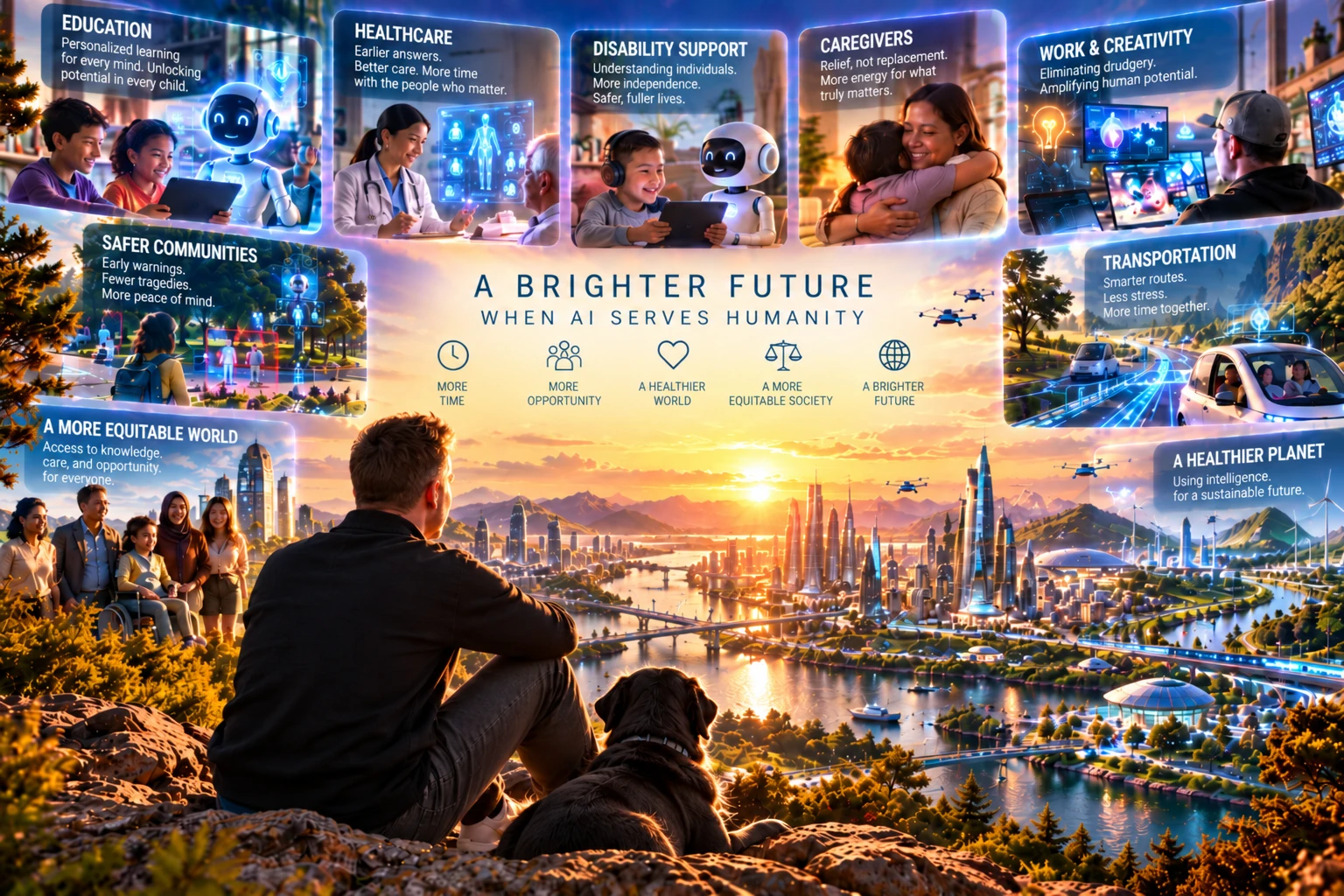
I hope we look back and say AI removed enormous amounts of drudgery from human life.
- That it took work humans hated doing and gave us more time for work that mattered.
- That it made education more accessible.
- That it helped science move faster without making scientific reasoning less rigorous.
- That it helped people with disabilities participate more fully in the world.
- That it gave overwhelmed families additional capacity.
- That it raised the bottom instead of only raising the ceiling.
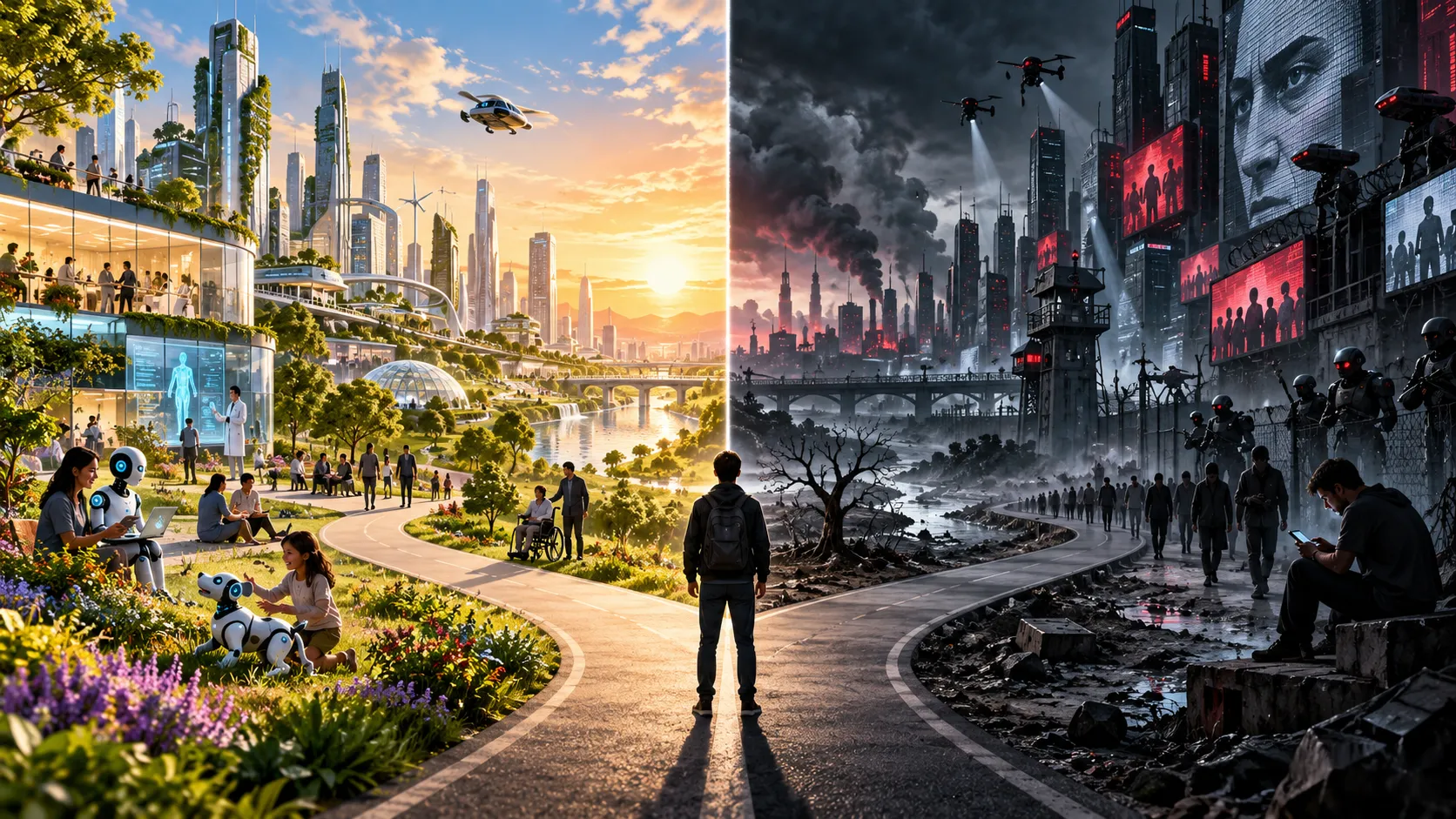
- That increasingly capable systems also became increasingly understandable, accountable, and deserving of trust.
And that we remembered something fundamental while building them:
The purpose of intelligence is not simply to produce more output.
It is to help us make better decisions about what is worth producing at all.
I want AI to become extraordinarily capable.
But capability is not the finish line.
The outcome I care about is whether that capability gives people more agency, more opportunity, and more time to actually be human.